
How To Register A New Company

The following will be discussed in this article of How To Register A New Company.
Types of Company | Steps To Register A New Company | Creating a Digital Signature | GST Registration | GST Returns | Obtaining PAN and Income Tax Compliance |Trademark Registration | Copyright Registration |
Inspired by many queries, I felt it is important to share the knowledge of how to register a new company in India. This article will focus on the mechanism to setup an organization with respect to taxation [GST and Income Tax] company registrations and compliance.
For the sake of simplicity, will assume the following vital steps which are pre requisite work flow for any business setup has been already completed / followed.
-
-
Readiness of a business plan with requirement of fund,
-
Finalizing business partners (if any),
-
A physical location for having an office,
-
Aware of benefits and liabilities of each type of company to be chosen
-
Risk assessment and
-
Future processes for locating or reaching prospective customers
-
-
-
Importantly choose a name and logo for the business, which has to go for approval process with MCA (Ministry of Corporate Affairs)
-
Also, do not forget study landscape of your business and special homework on the competition to the trade already available or grow in future.
-
These days most of the incorporation task is done electronically hence the task at hand is progressively becoming friendlier and simpler.
Let us first understand broad classification of type of companies before going in to registration of a company.

One Person Company – This type of company (OPC) offers a great proposition to any entrepreneur who is opting to start and business. This type of company is also a separate entity from its owner. This type of company has been introduced in the year 2013 and has a upper cape of annual turnover of Rs.2 crores. Even though this type is very popular among startups, there are some restrictions in this type of company e.g. this type of company has to nominate a person with his/her consensus as a nominee. This type of company cannot carry out Non-Banking Financial (NBFC) activities including investment in securities etc.
Sole Proprietorship – here in this type of company, the whole procedures of the business and the operation is handled by one single person. Meaning, the owner and the company is treated as one single entity.
Limited Liability Partnership – This type is popularly known as LLP. It can be started with a minimum of two members/partners. Like OPC, an LLP is also a separate legal entity from the partnership and personal and business assets are distinguished. There are many advantages of this type of company formation over others. However, an LLP cannot be converted to a company if required at a later date. e.g. an LLP Company is lesser flexible regarding ownership of the enterprise compared to Private Limited Company due to easy transfer of shares and some similar compliances.
Private Limited Company – A Private limited company is a separate legal entity held by a few individuals. This type of company can be started with a minimum of 2 members and a maximum of 200 members.
Section 8 Company– This type of company is meant for a non-profit organization and requires special approval from authorities. They enjoy a special status in many respect.
Public Company – this type of company is formed and owned by its shareholders. This type of company acts as a separate legal entity from its owners.
Since the objective of this article is to share knowledge for startups / business initiators, we will not discuss processes for forming a Public Limited Company.
A Guide To Register A Private Limited Company
A private limited company is regulated by Companies Act 2013 and the Companies Incorporation Rules 2014 and is governed by the MCA [Ministry of Corporate Affairs]
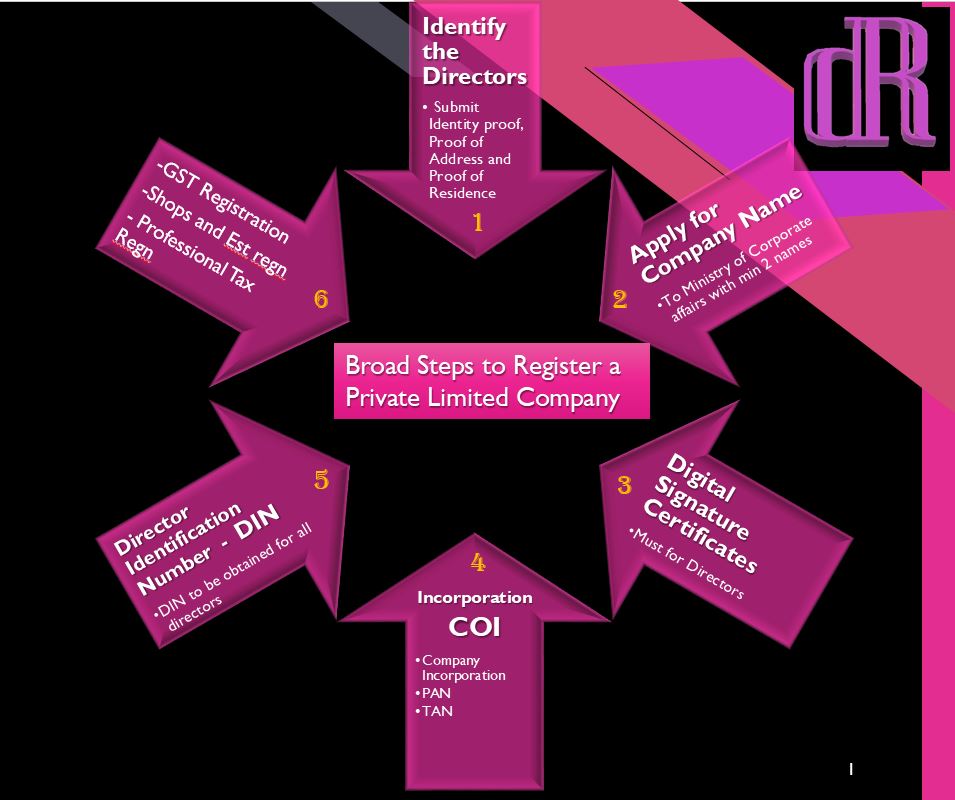


Identify the Directors
-
- Submit Identity proof, Proof Address and Proof of Residence
Apply for Company Name
-
- To Ministry of Corporate affairs with min 2 names
Digital Signature Certificates
-
- Must for Directors
- A Video KYC is required to be submitted to the department upon receipt of a message with a link to
Incorporation – COI
-
- Company Incorporation
- PAN
- TAN
Director Identification Number – DIN
-
- DIN to be obtained for all directors
Other registrations
-
- -GST Registration
- -Shops and Est regn
- – Professional Tax Regn
One can refer to http://www.mca.gov.in/MinistryV2/incorporation_company.html for detailed government instruction.
Once the above processes are done with, the new company now can go for opening bank account. Regular offers from a bank are given below. Readers are requested to check with the particular bank they are dealing with:
-
-
Cash Deposit: it is usually free up to a limit which is related to average monthly balance maintained
-
Cash Withdrawal: usually free at Home Branch & free up to certain amount (related to average monthly balance) at other branches of the bank
-
Anywhere Cheque Collections & Payments. : usually, it is free across locations where a branch of the bank is available
-
Personalized Payable-at-par / Local Cheque leaves
-
Certain numbers of Pay Orders & Demand Drafts Free in a month
-
monthly account statement: also should be free
-
Business Debit Card
-
Some important other services are also offered by the banks which are important for running a company
-
-
Cash Management Services (CMS)
-
Working Capital Facilities
-
Cash Credit Facilities
-
Overdraft against Property
-
Term Loans
-
Structured Cash Flow Financing etc
-


Once the company setup is done in all respect, the management should look at smooth operation and statutory requirements for functioning of an origination parallel to the main stream business needs. These activities are required to be monitored for being a good compliant organization:
-
-
-
Payroll
-
Provident fund
-
Professional tax
-
Regular Secretarial Compliances
-
Book Keeping and Accounting
-
Audit requirement: both the internal and statutory requirement.
-
Filling of Tax returns (GST, IT and PT)
-
RBI/FEMA compliances
-
-